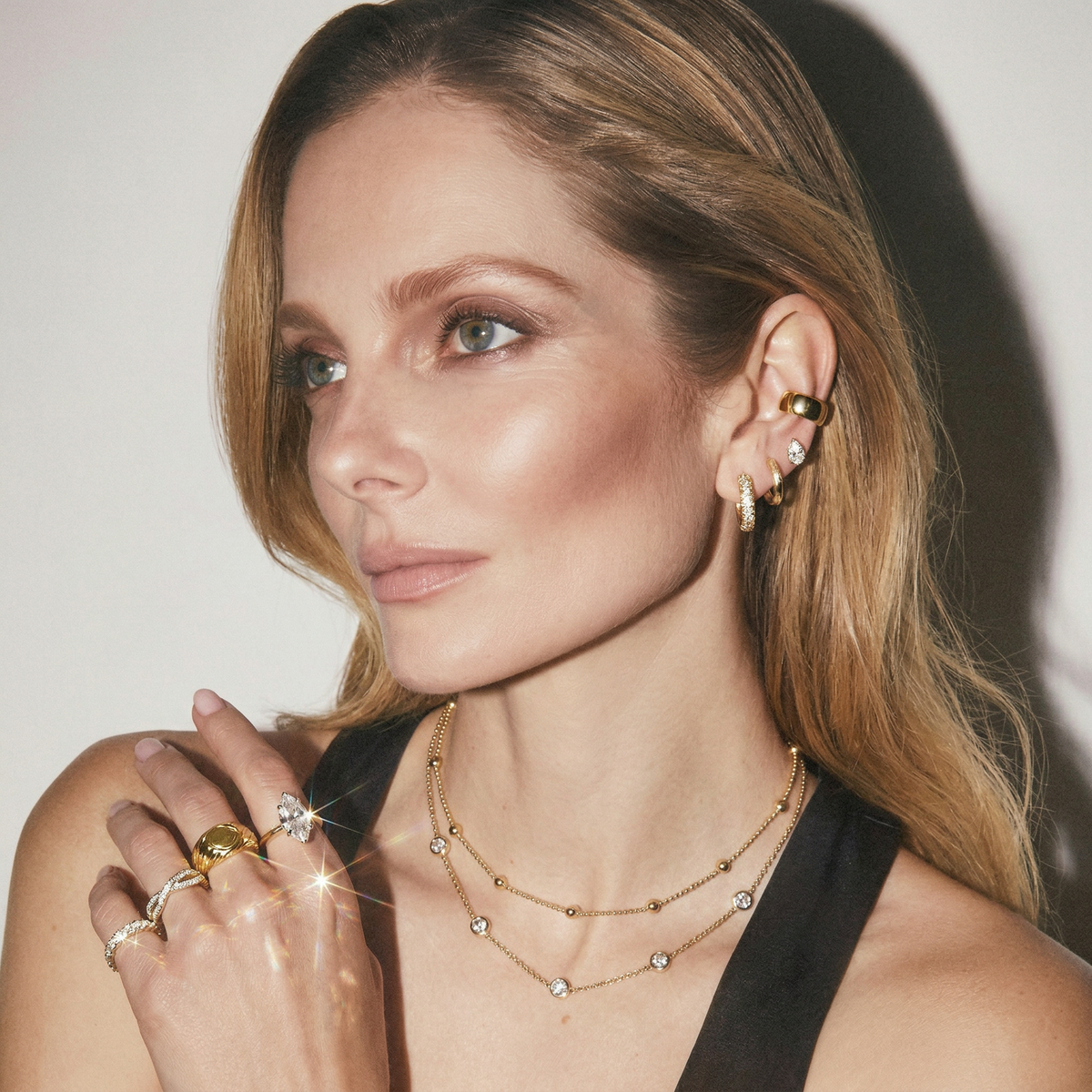


Tennis Bracelet Length: How Should It Fit?
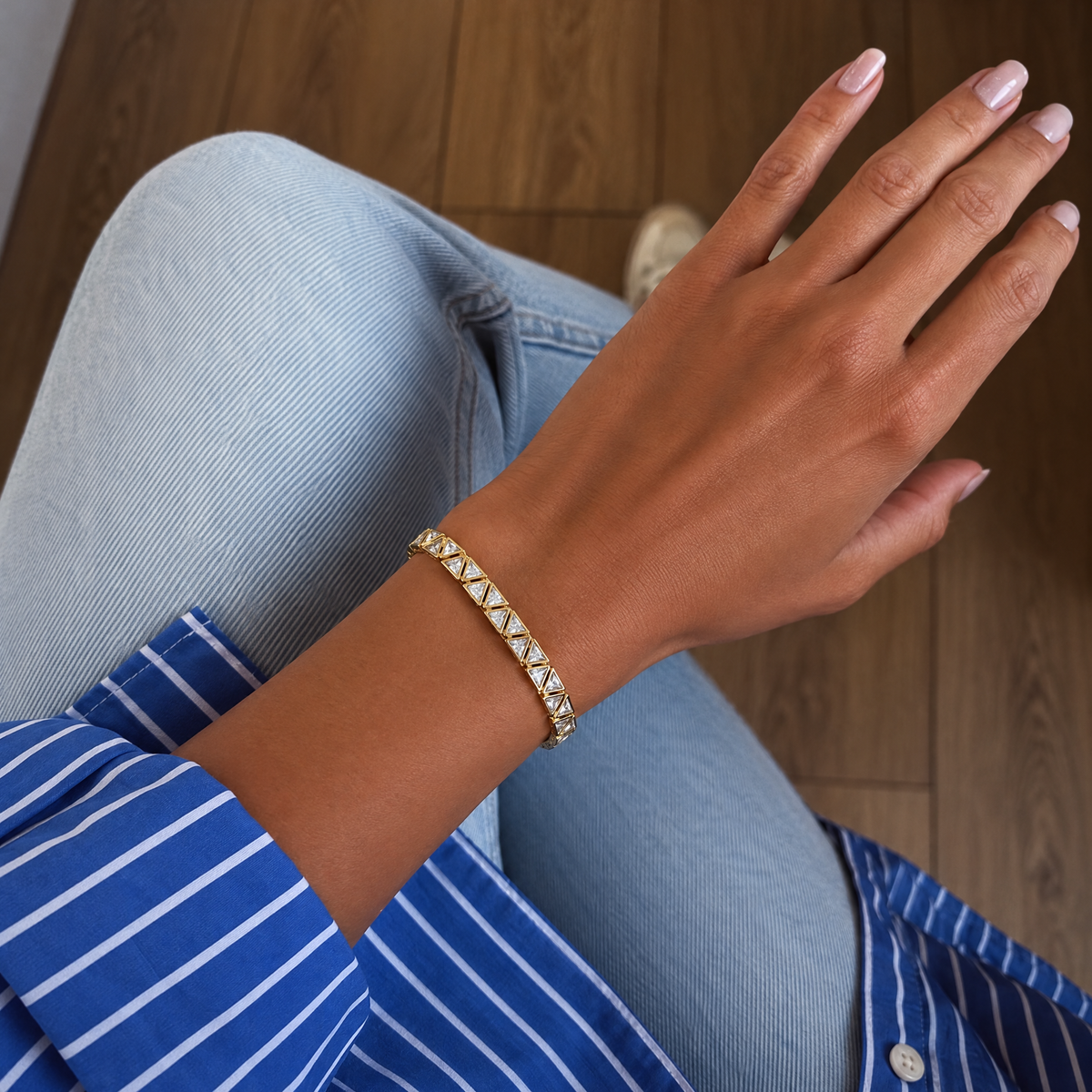
A tennis bracelet should sit comfortably around your wrist with a little movement, without pinching when you bend your hand or sliding off over it. Choose the length by measuring your wrist and comparing a similar bracelet you already enjoy wearing. The bracelet's stated length is not automatically the wrist size it will fit.
How should a tennis bracelet fit?
Think of a line of stones that moves with your hand, not something you keep pushing back into place. A little movement is part of the appeal. The bracelet should still feel secure when your arm hangs naturally and comfortable when you rest your hand on a table.
A common starting check is enough space to slip one finger beneath the bracelet without forcing it. Jewelers including Brilliant Earth use this guideline. It is an approximate comfort check, not a substitute for measurements: finger sizes and bracelet constructions vary.
- Too close
- The bracelet feels restrictive as you bend your wrist, or you have to pull its ends tightly together to fasten it. Do not choose that fit simply to keep the stones in one position.
- Too loose
- It repeatedly slides farther onto your hand than you want, or could pass over your hand while closed. Compare a shorter length rather than relying on another bracelet to hold it back.
- Comfortably fitted
- You can fasten it without tension, move your wrist normally and enjoy a little movement without constantly repositioning it.
How to measure for a tennis bracelet
1. Measure the wrist you plan to use
Wrap a flexible measuring tape around the place where the bracelet will sit. Keep it against your skin without pulling it tight. With no measuring tape, use a non-stretch paper strip, mark the overlap and measure the strip flat with a ruler. Record this as your wrist circumference, not your bracelet length.
2. Compare a bracelet that already feels right
Choose a flexible bracelet of similar width, rather than a rigid bangle. Unfasten it and measure its length without stretching the links. Note how the clasp closes and ask whether the new product's stated measurement includes the fastening. An extender tail that hangs beyond the clasp is not part of the loop around your wrist.
3. Allow the amount of movement you prefer
Use both measurements when comparing sizes. For example, a 16 cm wrist and a bracelet listed at 17 cm have a numerical difference of 1 cm; the difference with a 19 cm bracelet is 3 cm. That arithmetic helps compare options, but does not guarantee the fit of a particular setting or clasp.
The same approach appears in our bracelet size guide: measure where the piece will sit, then compare its wearable length while allowing the movement you enjoy. With no comfortable reference bracelet, an in-person fitting can be more useful than guessing an allowance.
Tennis bracelet lengths in centimeters and inches
Use the same unit when comparing listings. A size rounded to 7.5 inches may be specified more precisely as 19 cm elsewhere. For a close decision, work from the seller's stated measurement rather than rounding it to the next whole inch.
| Bracelet length | Approx. inches |
|---|---|
| 16 cm | 6.30 in |
| 17 cm | 6.69 in |
| 18 cm | 7.09 in |
| 19 cm | 7.48 in |
| 20 cm | 7.87 in |
Conversions use 2.54 cm per inch, rounded to two decimal places. The table describes jewelry lengths, not a universal fit chart.
17 cm or 19 cm: compare the actual design
Within the DEBACQ tennis bracelet collection, length options differ by piece. The Mixed-Cut Prism comes in two lengths; the Baguette and Pavé design has one listed length. Choose the pattern you like, then check whether its available size works for you.
These are two separate sizes, not one adjustable bracelet. On the same wrist, the 19 cm version provides more length than the 17 cm version. Neither is inherently the correct everyday size. Compare each with the fit you have measured.
There is no extender listed for this piece. A 17 cm length may be close-fitting on one wrist and roomier on another. Do not choose it on the assumption that a jeweler can add length afterward.
Gold-plated versions pictured separately, not to scale or as a measured fit comparison. Both designs use cubic zirconia and plated brass, not diamonds or solid gold. Current prices and options are on the product pages.
What if you fall between two bracelet lengths?
Do not automatically choose the larger size when the gap between options is substantial. If a similar 18 cm bracelet is your favorite fit, neither a 17 cm nor a 19 cm version reproduces it exactly. Ask about the design before deciding whether you would prefer a closer or looser alternative.
Check width and setting height alongside length. An enlarged product image cannot tell you how a piece will feel while typing or under a cuff. For a wrist that needs a shorter design, compare minimum fastening lengths rather than relying on the word "adjustable."
How to unclasp a tennis bracelet
First identify the fastening. For a box clasp with side safety catches, release the catches before operating the main clasp's release and gently separating its two parts. A lobster clasp opens with its small lever instead. The exact release mechanism varies, so follow the instructions for the piece you own.
Support the bracelet over a soft surface and hold near the clasp, rather than pulling on the stones. Do not try to drag a closed tennis bracelet over your hand as though it were a slip-on bangle. If the release is unclear or stuck, stop and ask for help instead of applying force. A clasp that no longer stays closed needs attention before the bracelet is worn again.
Buying a tennis bracelet as a gift
Keep the design a surprise, not necessarily the measurement. Ask which bracelet length the recipient enjoys, or use the specification of a similar piece on their wish list. Clothing size and a model's wrist are not useful substitutes for that information.
Confirm the metal preference as well. A white-gold-plated finish over brass is a cooler color option, not sterling silver. For sizing help, contact DEBACQ with the product name and preferred length before ordering. Check the delivery information and current return terms for a gift needed on a particular date.
Tennis bracelet length questions
Is a 7-inch bracelet the same as 17 cm?
No. Seven inches is 17.78 cm, while 17 cm is about 6.69 inches. Compare the exact listed length when fit is close. Rounding 17 cm up to seven inches hides a difference of almost 8 mm.
Can a tennis bracelet be shortened?
Some designs can be altered, but the construction determines what is possible. Ask the seller or a jeweler about the exact piece before purchasing it with a plan to remove links. Do not assume every plated or patterned bracelet can be resized without affecting its finish or design.
Should a tennis bracelet stay completely still?
A little movement can be comfortable. Choose the size for security and freedom to bend your wrist, not to prevent every shift in position. If the bracelet moves more than you like, compare its length and construction rather than forcing a tight fit to keep one section facing up.
Find the length. Enjoy the detail.
A tennis bracelet is easier to enjoy when you are not constantly adjusting it. Start with a fit you understand, choose the stone pattern you love and let one piece be enough. The right length makes room for both comfort and the design.
Explore DEBACQ tennis bracelets
Written by Ben Levante