

Baguette vs. Emerald Cut: What Is the Difference?
Baguette and emerald cuts can look similar, but their corners are the quickest way to tell them apart. A traditional baguette has square corners; an emerald cut has clipped corners that create an eight-sided outline. Both commonly use step-cut facets. Neither name tells you whether the stone is a diamond, an emerald or another material.
Baguette vs. emerald cut: the main differences
Start with the outline, then look at the pattern inside the stone. The flat, polished surfaces are called facets. In a step cut, they form a series of parallel levels rather than the triangular and kite-shaped pattern associated with brilliant cuts.
- Corners
- A classic straight baguette keeps its four square corners. An emerald cut has a short diagonal edge at each corner.
- Proportions
- Baguettes are often slender, but they can also be nearly square or tapered. An emerald cut can have a longer or squarer outline, so length alone is not a reliable way to identify it.
- Facet pattern
- Both belong to the step-cut family in their traditional forms. The outline and the arrangement of facets need to be considered together; not every rectangular stone has the same cut.
GIA illustrates these distinctions in its guide to baguette diamonds and explains the difference between outlines and facet arrangements in its guide to diamond shapes.
What is a baguette cut?
A traditional baguette is a small step-cut stone, usually rectangular. Straight baguettes have parallel long sides. Tapered baguettes narrow toward one end. In diamond jewelry they are often used as side stones or repeated accents, rather than only as a single center stone.
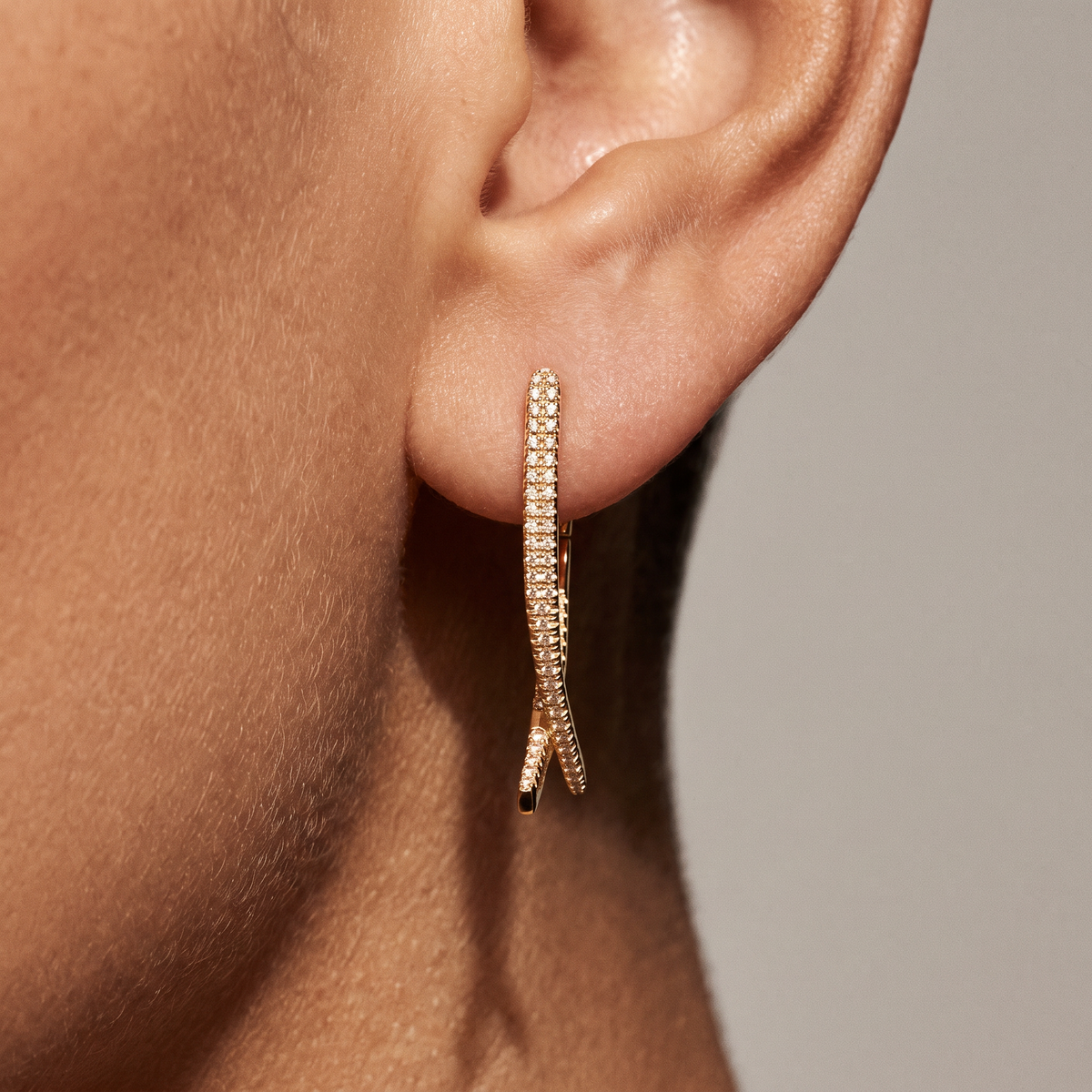
In a finished design, repetition can be as important as the individual stone. A row of small rectangles around a hoop gives a different effect from one larger stone on a plain band. Look at how the sequence follows the jewelry's outline, not just at a close-up of one rectangle.
For everyday styling, try that repeated detail beside a plain collar or smooth knit. Let the geometry be visible before deciding whether to add another patterned piece.
What is an emerald cut?
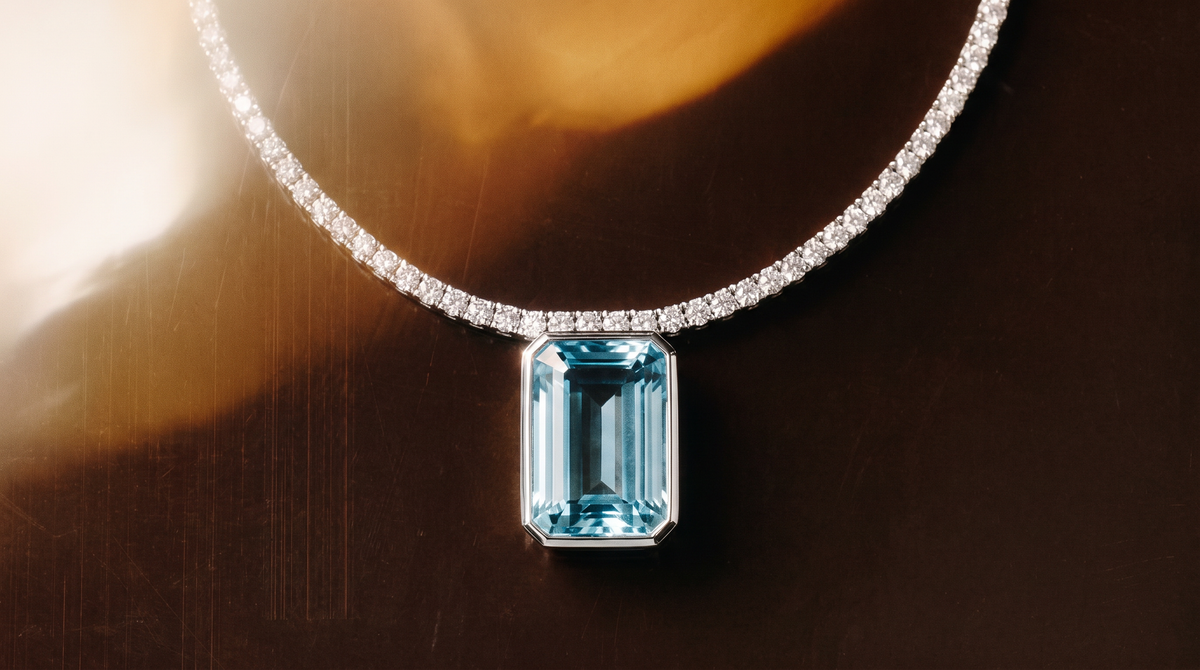
An emerald cut has a rectangular or square overall shape with the corners cut away. Its step-like facets create a different pattern from a round brilliant. The clipped corners are part of the stone's outline, not simply the shape of the metal holding it.
The name does not mean that the stone is green or made of emerald. An emerald-cut diamond is a diamond with that cutting style. Emerald-cut cubic zirconia is cubic zirconia, not diamond or emerald. Read the stone description separately from the name of the cut.
As a styling choice, try a single geometric stone against a simple metal surface. It gives you one clear detail to build around, whether you choose it for a bracelet, a pendant or a ring.
A cutting style is not a stone material
The two featured pieces use white cubic zirconia and plated brass, not diamonds or solid gold. Cubic zirconia is also different from a laboratory-grown diamond. GIA explains the distinction in its guide to diamond simulants and laboratory-grown diamonds.
Setting terms describe something different again. Baguette identifies a cutting style, while pavé describes an arrangement of closely set small stones. For more on reading those details, see what pavé means in jewelry.
Compare like with like when choosing: the same kind of stone, clearly stated metal and finish, and the actual dimensions. A familiar cut name is not a substitute for that information.
Does an emerald cut sparkle more than a baguette?
The name alone is not enough to judge the finished result. Facet proportions and workmanship affect how a diamond interacts with light, as GIA explains in its guide to diamond cut. Do not apply a diamond cut grade or a claim about diamond performance to a cubic-zirconia piece without evidence.
When shopping online, compare photographs taken at more than one angle and look for video where available. A close-up of one center stone and a distant photograph of small accent stones are not a fair sparkle comparison. Choose the pattern you enjoy seeing rather than assuming one name guarantees more shine.
How to choose the look you will wear
For repeated geometry
Look at a row of baguette-cut stones in earrings or a necklace. Try it with plain fabric first, so the individual rectangles remain visible. The Baguette-Cut Tennis Necklace is another way to wear that pattern. Its listed length is 16 inches (40.6 cm); compare it with a necklace you already wear before choosing.
For a single focal point
Start with one geometric stone on an otherwise simple piece, such as the bangle above. Consider where you want the detail: beside your face, at the neckline or on the wrist. The same preference for clean lines can lead you to quite different pieces.
For a combination of both
You do not have to choose one cut for your entire jewelry collection. Try baguette earrings with a single-stone bracelet, keeping another detail consistent, such as the metal tone. The two pieces shown here are individual product examples, not a photographed matching set or a to-scale comparison.
For outfit ideas built around a geometric necklace, continue with our guide to how to style a tennis necklace.
Three details to check before ordering
Proportion: use the measurements, not just the enlarged product image. Consider the full earring length or bangle opening as well as the stone. Our size guide explains the relevant measurements for different pieces.
Finish: choose the metal color you enjoy wearing, then confirm what the piece is made of. White gold plating over brass is not sterling silver, even when both have a silver-toned look.
Construction: look at the fastening and side views. Missing dimensions are worth asking about before buying, especially when you are comparing a close-fitting earring or bangle with a piece you already own.
Baguette and emerald cut questions
Is a tapered baguette an emerald cut?
No. A tapered baguette narrows toward one end. That change in width is different from the clipped corners that characterize an emerald cut.
Are baguette stones only used in engagement rings?
No. You will also find baguette-cut stones in earrings, bracelets and necklaces. The term describes the cut, not the occasion or the category of jewelry.
Can you identify the stone material from its shape?
No. Different materials can have similar outlines and cutting styles. Use the product's material description; a rectangular shape or a bright photograph does not establish that a stone is a diamond.
Find your kind of geometry
A row of small rectangles or a single clipped-corner stone. Choose the detail you are drawn to, then check the material and fit. The right piece is the one you can picture wearing beyond its product photograph.
Explore the jewelry collection
Written by Ben Levante