

Article: Necklace Chain Types: A Guide to Links and Styles
Necklace Chain Types: A Guide to Links and Styles
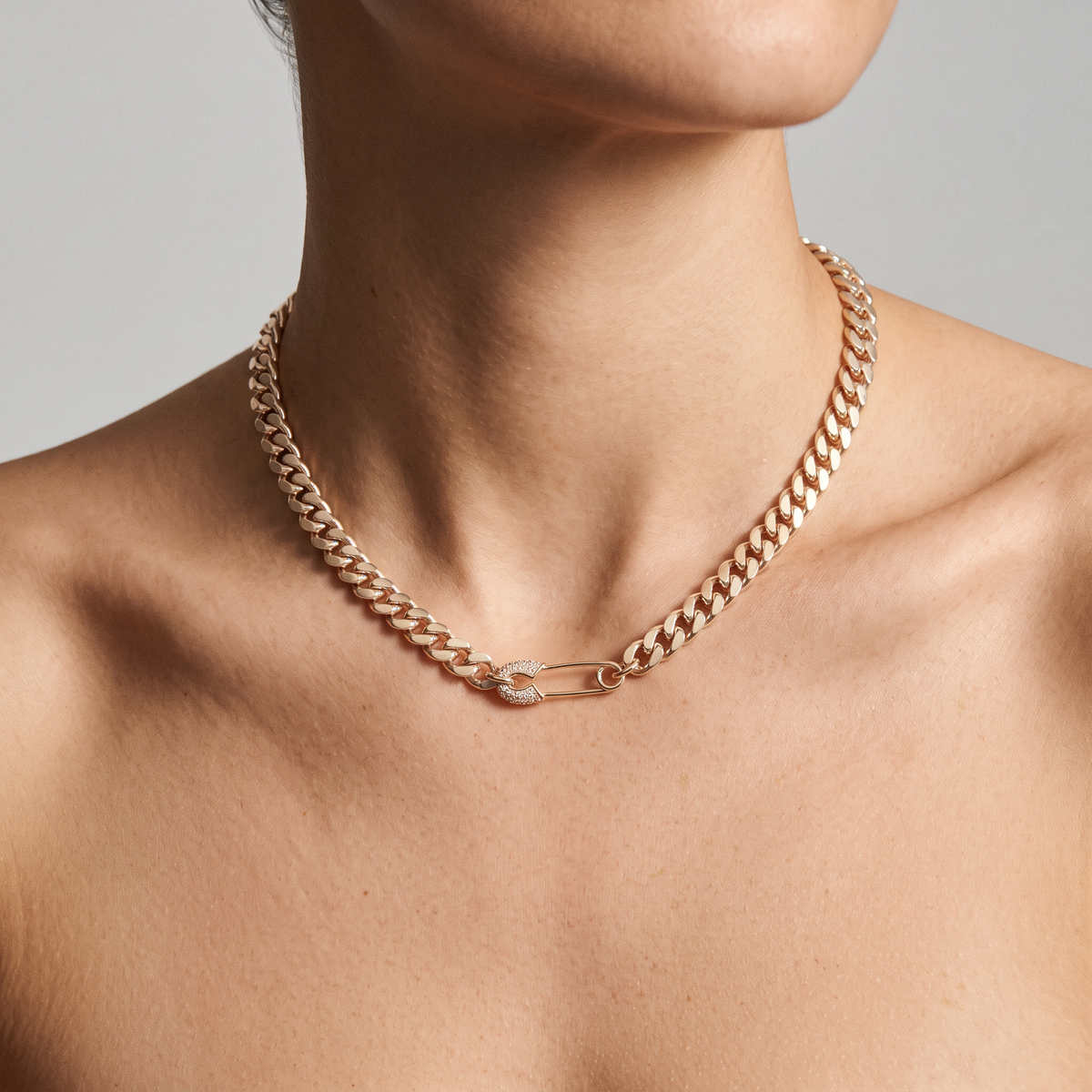
Common necklace chain types include cable, rolo, curb, Figaro, rope, box, snake, herringbone and paperclip. The names describe the pattern or construction, not the metal or quality. Choose a chain around what you want it to do: carry a pendant, add texture to a layered look or become the main detail at your neckline.
Nine necklace chain types and how to recognize them
Look at one link first, then at the whole necklace. Can you see separate loops, a twisted pattern or a smooth surface? These clues help you describe the chain you like and compare it with another listing. This is a general reference, not a list of every style currently stocked by DEBACQ.
- Cable
- Similar oval or round links repeat in a simple connected sequence. The open loops remain individually visible.
- Rolo
- Rounded links have a fuller profile than a fine cable chain. Look for the repeated circular outline and visible spaces inside.
- Curb
- Links are shaped to lie flat against one another. Closely packed Cuban links give a related, more substantial-looking pattern.
- Figaro
- Groups of shorter links alternate with a longer oval link. The changing link length is the recognizable detail.
- Rope
- Connected links form a spiral resembling twisted rope. You notice a textured strand rather than a row of separate open loops.
- Box
- Closely connected square links create a boxlike profile. A necklace of large decorative rectangles is not automatically this construction.
- Snake
- Tightly connected curved sections create a smooth, nearly continuous surface. The individual segments are less obvious from a distance.
- Herringbone
- Flat, angled segments meet in a V-shaped pattern. Think of a ribbon of metal rather than a rounded cord.
- Paperclip
- Elongated open links resemble paper clips. The spaces inside the links are a prominent part of the design.
For further construction references, see Brilliant Earth's chain guide and The Chain Hut's chain-style guide. Compare the actual links as well as the name when a seller uses a different description.
Which type of necklace chain should you choose?
For a pendant you already own
A fine cable or box chain is a useful starting point. Before buying, check that the chain's end fitting can pass through the pendant's hanging loop, called the bail. The clasp or end ring may be wider than the chain itself. Ask the seller whether the chain is suitable for the pendant's weight, rather than choosing by appearance alone.
A decorative link necklace may be designed to stand alone. Do not assume its open links are attachment points for extra charms, or that every necklace can carry an existing pendant.
For a necklace worn on its own
Choose the pattern you want to see across the neckline. An open link leaves space between sections of metal; a rope-like texture or ribbon-shaped design creates a more continuous line. Try it with a plain top before adding other jewelry. One clearly visible chain can be the whole idea.
For a layered look
Begin with a necklace you already enjoy wearing, then compare a second piece with a different length or outline. Leave room for both designs instead of resting one pendant on the other chain. A different chain type can make the layers easier to distinguish, but it does not guarantee they will never cross or tangle.
Two decorative link necklaces from DEBACQ
Our Chain & Link Necklaces include designs that use the link itself as decoration. The two examples below are not plain pendant chains: one emphasizes open rectangles and stones, while the other repeats polished discs. Choose between the visible patterns, not a claim that one is the stronger chain.
Both necklaces have a listed length of 41 cm, but they do not have the same link shape or surface. Compare that length with a necklace you wear comfortably, and check the width before choosing for a particular neckline. The shared measurement does not mean they will sit identically on every wearer.
Gold-plated versions pictured individually, not to scale. These are examples from our collection, not a wear-test comparison. Product pages show current prices and available finishes.
Prefer the same idea at the wrist?
You can enjoy a link pattern without making it your necklace. Explore Chain Bracelets when you prefer to keep a favorite pendant in place or leave your neckline bare. Choose for the wrist fit separately; a necklace measurement cannot tell you the bracelet length you need.
The pieces need not be an exact set. Try an open-link bracelet with a simpler necklace, or let a decorative chain stand alone on one wrist. Repeat a shape because you like it, not because buying one piece commits you to the rest of a collection.
What to check before buying a chain necklace
Length and width are different decisions
Measure a comfortable necklace and compare its usable length, including the clasp, with the listing. Then check the new chain's width in millimeters. A shorter chain is not necessarily a finer one. Our Size Guide explains how to compare the length with your proportions and intended neckline.
Read the metal separately from the pattern
Paperclip, rope and curb describe designs, not gold content. The DEBACQ examples above use gold plating over brass, not solid gold. The white-gold-plated option is not sterling silver. Read the complete material description even when two necklaces look similar in their photographs.
Look at the fastening and the complete piece
Check how the clasp opens and whether the listing includes an extender. For an unlisted width, weight or pendant-compatibility question, contact us with the product name. Review delivery information and the current return terms before ordering for a gift or event.
Necklace chain questions
Which necklace chain type is the strongest?
The type name alone cannot establish the strength of the finished necklace. Ask about the material, link construction, width, connections and clasp, especially for a chain carrying a pendant. A wider-looking product photograph is not a test of what the chain can support.
Are snake and herringbone chains the same?
No. A snake chain has a closely joined, smooth surface; a herringbone chain uses flat angled segments in a V pattern. Look at close-ups of the construction rather than treating every smooth, shiny chain as the same style.
Can you wear a chain necklace without a pendant?
Yes. The links can supply all the detail. A fine chain can be a quiet accent, while a decorative link necklace can be the main accessory. Start with the chain alone and add a pendant only when you prefer the look and the design supports it.
Let the links be the detail
An open rectangle, a repeated curve or a fine line holding something personal. Learn the pattern, confirm the fit and choose the necklace you can picture wearing. The chain does not have to be the background to another piece of jewelry.
Chain & Link Necklaces
Written by Ben Levante