

Types of Earrings and Earring Backs: A Buying Guide
Common types of earrings include studs, hoops, huggies, drops and dangles. Their names describe the visible design, while terms such as push back, screw back and hinged closure describe the fastening. Choose the shape you enjoy first, then check how it closes, how it fits and what it is made of. A small-looking earring is not automatically the easiest one to wear.
Types of earrings: names and differences
Start with where you want the detail: on the lobe, around it or below it. The names overlap, so a pair can belong to more than one style. The descriptions below are a reference for shopping, not a list of every design currently sold by DEBACQ.
- Studs
- A classic stud has a decorative front on a post, sitting at the lobe. It can be a single stone, a metal shape or a cluster, rather than only a tiny round accent.
- Hoops
- A curved or angular loop creates space inside the earring. Circles are familiar, but oval, rectangular and sculptural outlines are options too.
- Huggies
- Small hoops designed to sit close to the lobe. They belong to the hoop family, but their inside clearance is particularly important. Browse Hoop & Huggie Earrings for both approaches.
- Drops and dangles
- Both extend below the lobe. A drop often has a more defined outline; a dangle emphasizes freely moving sections. The names overlap. Explore Drop Earrings by their actual shape, not the label alone.
- Chandeliers and tassels
- A chandelier branches into tiers or several hanging elements. A tassel uses a fringe of strands. Compare their width as well as their length when choosing an evening pair.
- Threaders
- A fine chain or wire passes through the piercing and hangs on either side of the lobe. Check how much of the design sits at the front and how it is intended to be secured.
- Ear climbers
- An elongated design follows the ear upward instead of dropping below it. Its fastening and the space it needs vary with the individual piece.
- Cuffs and clip-ons
- A non-pierced cuff grips the edge of the ear; a clip-on fastens around the lobe. Check the construction, since some designs combine a cuff with a separate pierced-ear component.
Statement Earrings describes the impact of a design rather than one fastening. A bold stud, a sculptural hoop or a long drop can all make a statement. Choose the amount of detail you want without assuming that bigger is the only way to make a piece noticeable.
For additional style definitions, see Brilliant Earth's guide to earring types. Our drop vs. dangle guide looks more closely at the difference between a defined outline and a moving one.
Two DEBACQ designs: the front and the fastening
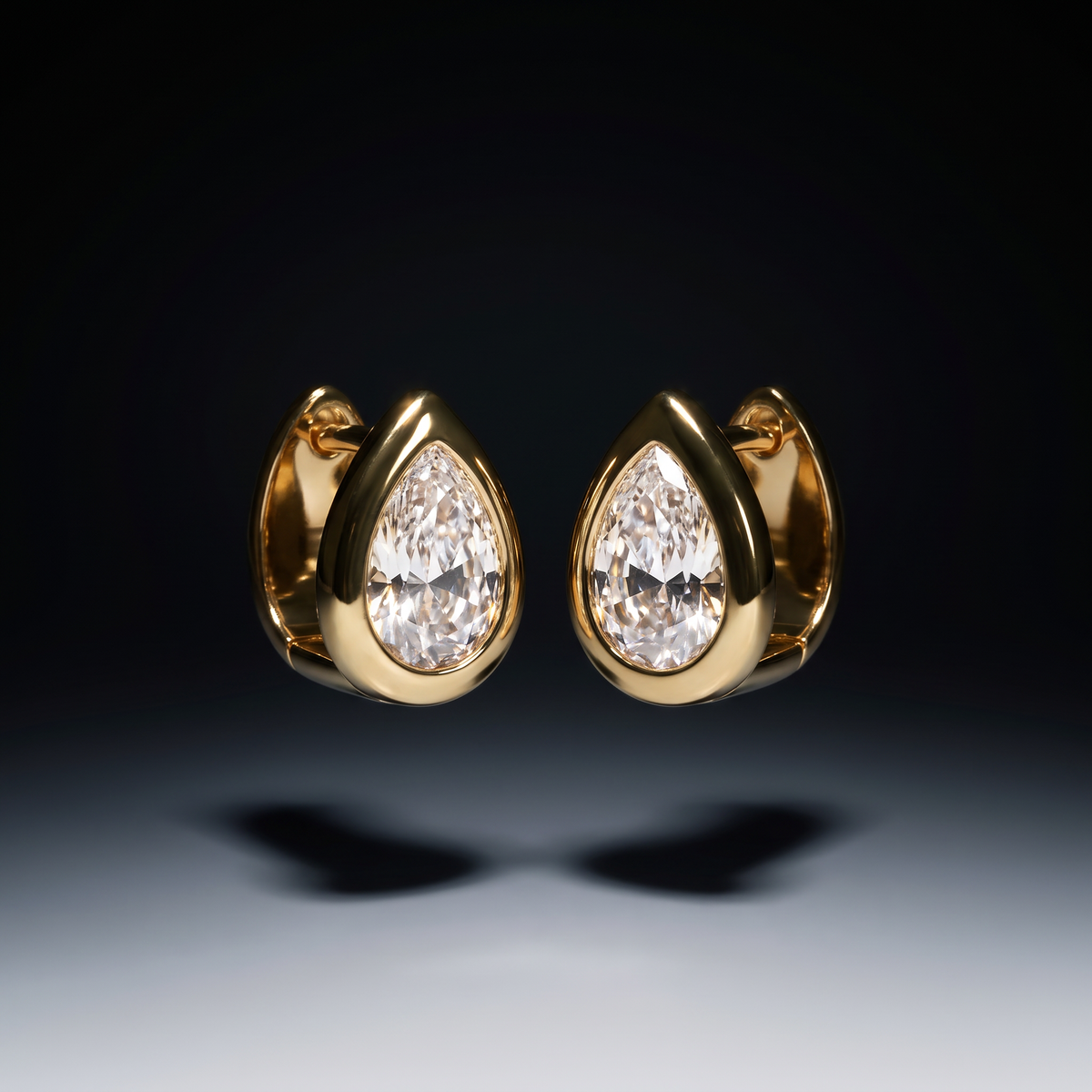
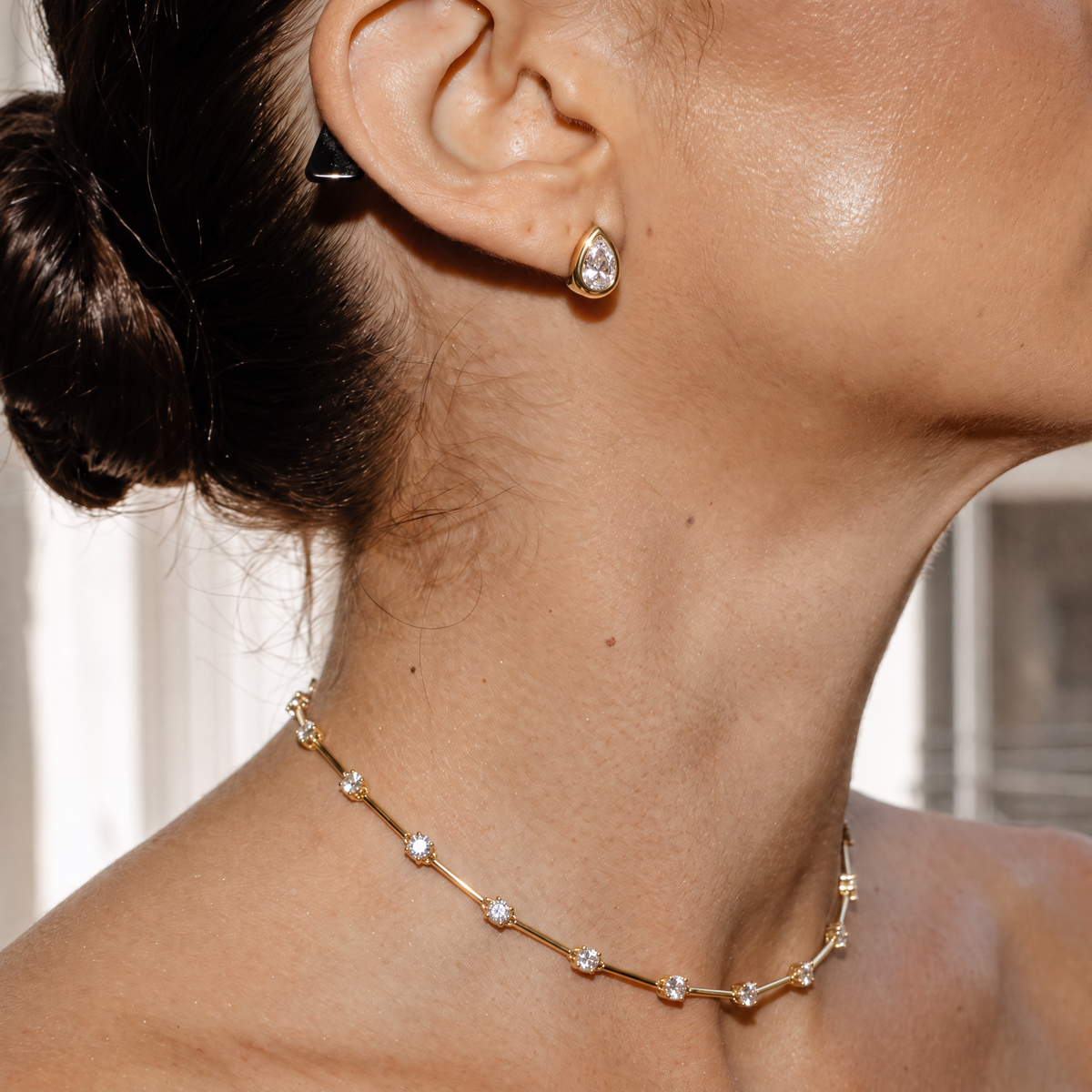
A photograph shows why you like a pair. The closure description tells you something different: how you will put it on. These two pieces make that distinction useful, with a hinged hoop and a linked design listed with a stud-back closure.
The hinge is part of the hoop itself. Before choosing for a close fit, confirm the space inside the earring as well as its overall dimensions. A teardrop-shaped hoop is not automatically a huggie.
Here, the word "studs" should not make you picture a single small dot on the lobe. Look at the full linked design too. The listing identifies a stud-back closure without specifying a push-back or screw-back mechanism, so ask before choosing a replacement back.
Gold-plated versions shown individually, not to scale. These are collection examples, not wear-test comparisons. Both use plated brass and cubic zirconia, not solid gold or diamonds. Product pages show current prices and options.
Types of earring backs and closures
Some earrings use a removable back; others have a fastening built into the design. Check which system the actual piece uses instead of assuming every stud, hoop or drop closes in the same way.
- Push or friction backs
- A separate back slides onto the post and grips it through tension. A butterfly back is a familiar form. Use a compatible back rather than forcing one that is too tight or loose.
- Screw backs
- A threaded back turns onto a matching threaded post. It needs twisting rather than a straight push or pull. Check the thread compatibility when replacing a lost back.
- Locking backs
- A locking mechanism secures the back to a compatible post; some release when side tabs are pressed. These are not simply another name for screw backs. Follow the specific release instructions.
- Hinged and latch closures
- Common on hoops, these close a post or arm into a catch on the earring. The mechanism varies. Check the closure in an open-and-closed view rather than assuming every hinge works identically.
- Lever backs
- A curved wire is secured by a hinged lever behind the lobe. This creates a closed loop and is often used on hanging designs. There is no separate butterfly back to attach.
- French or fishhook wires
- A curved wire passes through the piercing and rests behind the lobe. An open hook has no closing lever. Ask whether the maker supplies or recommends a compatible stopper.
For fastening illustrations and terminology, see Blue Nile's earring-closure guide and DiamondStuds' comparison of stud backings. The mechanisms listed here are a general reference, not a claim that DEBACQ stocks every type.
The most useful fastening is one you can operate comfortably and that closes as intended. No label guarantees that an earring cannot be lost. Stop wearing a piece whose catch will not stay closed, and ask for help rather than bending it back into place.
How to choose an earring style you will wear
Start with the clothes and accessories you already use
For a weekday pair, try a compact stud or hoop with your usual shirt and glasses. For dinner, compare that same pair with a longer design and an open neckline. The occasion does not require a larger earring; choose the amount of detail you like seeing.
Measure the outline and the space inside it
Compare total height and width with a comfortable pair you own. For hoops, check inside clearance separately. Weight is another specification, not something you can reliably infer from diameter. Our earring size guide explains which dimensions to compare.
Read the material description separately
Hoop, stud and chandelier do not name a metal. The two DEBACQ examples above use gold-plated or white-gold-plated finishes over brass, with white cubic zirconia. Choose for those materials rather than assuming a silver-toned appearance means sterling silver.
Before a gift purchase, confirm whether the recipient wears pierced or non-pierced jewelry and whether the listing sells a pair or a single earring. For missing measurements, weight or closure details, contact DEBACQ with the product name. Resolve those questions before ordering: our return policy lists earrings as non-returnable for hygiene reasons. Read the full terms, including any applicable regional provisions.
Earring style and backing questions
Are all small hoops huggies?
Not necessarily. Huggie describes a close-fitting hoop style, not one universal diameter. Compare the inside opening and your piercing position. Our huggie and hoop comparison explains how the fit can differ.
Does a stud back mean the earring has no hanging parts?
No. A post-and-back fastening can support a decorative design that extends below the lobe. "Stud back" describes how the piece fastens, while the full product photograph shows the shape you will see at the front.
Are replacement earring backs universal?
Do not assume so. Posts, threads and locking mechanisms need matching components. Ask the seller or a jeweler to identify the correct replacement instead of testing a spare back by forcing it onto the post.
Choose the shape. Check the fastening.
A curve around the lobe, a linked line below it or a small detail you reach for each morning. Start with the silhouette you enjoy, confirm the fit and give one pair a place in your wardrobe.
Explore DEBACQ earrings
Written by Ben Levante